Search Icon
< Home /Press Releases /2016 FSF Press Releases /FSF Releases Analysis of Safety Benefits of Space-Based ADS-B Technology

FSF Releases Analysis of Safety Benefits of Space-Based ADS-B Technology

Jun 21, 2016

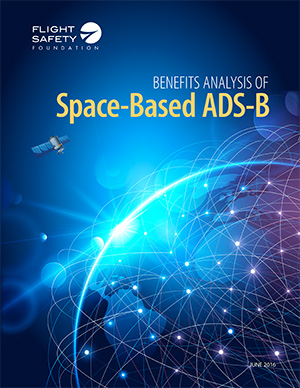
ALEXANDRIA, Va. — Flight Safety Foundation today released the study Benefits Analysis of Space-Based ADS-B, investigating the application of space-based automatic dependent surveillance-broadcast (ADS-B) networks to meet the predicted safety challenges of air traffic growth over the next 20 years.  The study also assesses how space-based ADS-B can enhance the world’s aviation network – both the systems and industry – by introducing a near-real-time flight surveillance capability that provides 100 percent global coverage.

Conducted over several months, the study identifies immediate, mid-term and long-term safety benefits of space-based ADS-B, and the integral role it can play in meeting both existing and future challenges facing the aviation industry.  It also includes a review of space-based ADS-B success factor challenges.

Among the existing challenges identified and the role space-based ADS-B can play to eliminate them, include:

  • Oceanic and remote airspace lacks surveillance — Space-based ADS-B will provide a critical near-real-time surveillance enhancement while also enabling reduced oceanic separation.  This may prompt a review of performance-based operations and the underpinning communication, navigation and surveillance (CNS) requirements in favor of reductions in separation minima.
  • Aircraft position errors that occur on or near the boundaries of two different flight information regions (FIRs) are still relatively common — The integrity and accuracy of space-based ADS-B should introduce significant safety benefits to avoid positional errors for aircraft within adjacent flight information regions (FIRs). In addition, handover between air traffic controllers (ATC) at FIR boundaries should be more precise due to near-real-time situational awareness, reducing ATC and pilot workload and the negative influence on the overall safety net.
  • Current flight trajectory monitoring is generally limited to every 30 minutes in oceanic and remote airspace, which can result in significant off-track errors — With an anticipated data-update rate of once every 8 seconds, space-based ADS-B will introduce an almost real-time detection of aircraft not conforming with its intended and planned flight path, as opposed to the current standard of 30-minute updates.
  • ATC and pilot workloads are hampered by inefficient traffic management strategies over oceanic and remote airspace — Space-based ADS-B is expected to reduce controller and pilot workload, due to ADS-B’s ability to display an accurate and near-real-time picture for ATC.  This should facilitate more efficient planning and offer a wider array of traffic control and management tools, resulting in fewer errors.
  • Insufficient surveillance capabilities and lack of redundancy over designated conflict zones and volcanic ash clouds — In contested or obscured airspace where reliable surveillance is not available, space-based ADS-B should enhance strategic planning, contingency management and operational situational awareness. Space-based ADS-B should also support the pre-planning of more accurate and efficient diversion routes and improve the global safety net.
  • Locating “black boxes” can prove challenging to rescue teams and air accident investigators due to extensive search areas and inhospitable environments — When “black box” data is missing or unavailable, space-based ADS-B may provide supplementary time-critical flight data to assist in the investigation of aircraft incidents and accidents.  This should improve the timeliness of locating this valuable data.

Among these findings, specific “Success Factor Challenges” were also investigated, including:

  • ADS-B equipage rates — To derive the benefits of space-based ADS-B, avionics equipage mandates must be met and the will of states yet to encourage or mandate the use of ADS-B will be a highly influential consideration in securing the safety and efficiency gains.
  • Adoption by ANSPs — The implementation of space-based ADS-B will require some ANSPs to procure or upgrade existing ATC automation systems.  This interdependency is a requirement to ensure the service can be delivered.
  • Space-based ADS-B integrity — State regulatory approval and an evidence-based safety argument will be required to prove that the system can meet the latency and reliability requirements needed to comply with safety standards.  These regulatory activities are also relevant to the successful implementation of the key benefit of reduced separation.

“Space-based ADS-B has the potential to significantly improve flight safety, efficiency and the health of the industry overall,” said Greg Marshall, vice president, global programs for Flight Safety Foundation. “The ability to provide near-real-time global surveillance is a game changer for the aviation industry. This type of innovative capability comes along once in a generation. I think we can all agree, it is always safer when the controller knows exactly where the plane is, 100 percent of the time.”

For a copy of Benefits Analysis of Space-Based ADS-B, please click here.

Flight Safety Foundation

Flight Safety Foundation is an independent, non-profit, international organization engaged in research, education, advocacy and publishing to improve aviation safety. The Foundation’s mission is to be the leading voice of safety for the global aerospace community.

Contact: Frank Jackman, 703.739.6700 ext. 116; jackman@webdeva.flightsafety.org

ALEXANDRIA, Va. — Flight Safety Foundation today released the study Benefits Analysis of Space-Based ADS-B, investigating the application of space-based automatic dependent surveillance-broadcast (ADS-B) networks to meet the predicted safety challenges of air traffic growth over the next 20 years.  The study also assesses how space-based ADS-B can enhance the world’s aviation network – both the systems and industry – by introducing a near-real-time flight surveillance capability that provides 100 percent global coverage.

Conducted over several months, the study identifies immediate, mid-term and long-term safety benefits of space-based ADS-B, and the integral role it can play in meeting both existing and future challenges facing the aviation industry.  It also includes a review of space-based ADS-B success factor challenges.

Among the existing challenges identified and the role space-based ADS-B can play to eliminate them, include:

  • Oceanic an…

Popular Categories

Explore Articles

Auto-GCAS Saves Unconscious F-16 Pilot

AviationWeek.com‘s Guy Norris posted an extraordinary head-up display vi...

2011 Press Releases

December 21, 2011 FSF Statement on Fatigue Rules November 3, 2011 Civil Aviati...

2010 Press Releases

November 9, 2010 BASS Opens This Week in Singapore November 3, 2010 Foundation...

ICAO Secretary General to Deliver Keynote at FSF Networking and Awards Dinner

ALEXANDRIA, Virginia — International Civil Aviation Organization (ICAO) Secretary General Juan Carlos Salazar will deliver ...

Human Factors & Aviation Medicine 2005 – 2006

These documents are in Adobe® Portable Document Format (PDF) and require a copy of Adobe Reader® to view them. If you do no...

Foundation Recognizing EUROCONTROL and Embry-Riddle With Awards

The awards will be presented June 24 at the annual Networking and Awards Dinner in Washington....

Google Ads

FSF Releases Analysis of Safety Benefits of Space-Based ADS-B Technology

Jun 21, 2016

ALEXANDRIA, Va. — Flight Safety Foundation today released the study Benefits Analysis of Space-Based ADS-B, investigating the application of space-based automatic dependent surveillance-broadcast (ADS-B) networks to meet the predicted safety challenges of air traffic growth over the next 20 years.  The study also assesses how space-based ADS-B can enhance the world’s aviation network – both the systems and industry – by introducing a near-real-time flight surveillance capability that provides 100 percent global coverage.

Conducted over several months, the study identifies immediate, mid-term and long-term safety benefits of space-based ADS-B, and the integral role it can play in meeting both existing and future challenges facing the aviation industry.  It also includes a review of space-based ADS-B success factor challenges.

Among the existing challenges identified and the role space-based ADS-B can play to eliminate them, include:

  • Oceanic an…

Popular Categories

Explore Articles

Auto-GCAS Saves Unconscious F-16 Pilot

AviationWeek.com‘s Guy Norris posted an extraordinary head-up display vi...

2011 Press Releases

December 21, 2011 FSF Statement on Fatigue Rules November 3, 2011 Civil Aviati...

2010 Press Releases

November 9, 2010 BASS Opens This Week in Singapore November 3, 2010 Foundation...

ICAO Secretary General to Deliver Keynote at FSF Networking and Awards Dinner

ALEXANDRIA, Virginia — International Civil Aviation Organization (ICAO) Secretary General Juan Carlos Salazar will deliver ...

Human Factors & Aviation Medicine 2005 – 2006

These documents are in Adobe® Portable Document Format (PDF) and require a copy of Adobe Reader® to view them. If you do no...

Foundation Recognizing EUROCONTROL and Embry-Riddle With Awards

The awards will be presented June 24 at the annual Networking and Awards Dinner in Washington....

Google Ads

Related posts

View Archives

Dublin Selected as Site of IASS 2017

DUBAI, United Arab Emirates – Flight Safety Foundation Wednesday announced that the 70th annual International Air Safety Su...

Flight Safety Foundation Honors Three for Contributions to Safety

DUBAI, United Arab Emirates — Three long-serving members of Flight Safety Foundation’s Board of Governors were recognized...

IASS 2016 Starts Monday with Keynote from Emirates’ Top Safety Exec

DUBAI, United Arab Emirates — Flight Safety Foundation’s 69th annual International Air Safety Summit (IASS) gets under wa...

Flight Safety Foundation Publishes Flight Crew Guidance on Lithium Battery Overheating

ALEXANDRIA, Va. — Flight Safety Foundation has published on its website basic guidance on how flight and cabin crews should...

Focus on Critical Safety Issues, Maintenance and Engineering Track Highlight IASS Agenda

ALEXANDRIA, Va. — Lithium batteries, unmanned aircraft systems (UAS), automation and safety information protection are amon...

Help Us Make The Skies Safer

“For nearly 80 years, the Foundation has been a leading force in aviation safety around the world. Our work is made possible by our members. Join today to help ensure that the Foundation remains the authoritative voice on all matters pertaining to aviation safety.”

– Hassan Shahidi | President and CEO

G-R25C05ZKWX