On Sept. 2, 1998, Swissair Flight 111 experienced an in-flight fire and crashed into the Atlantic Ocean off the coast of Peggy’s Cove, Nova Scotia, Canada, killing all 229 passengers and crew.1 That accident, almost more than any previous one, was responsible for the industry’s reconsideration of the type of guidance given to flight crews when responding to in-flight, un-alerted smoke, fire and fumes (SFF) events, such as air conditioning smoke or electrical fires.
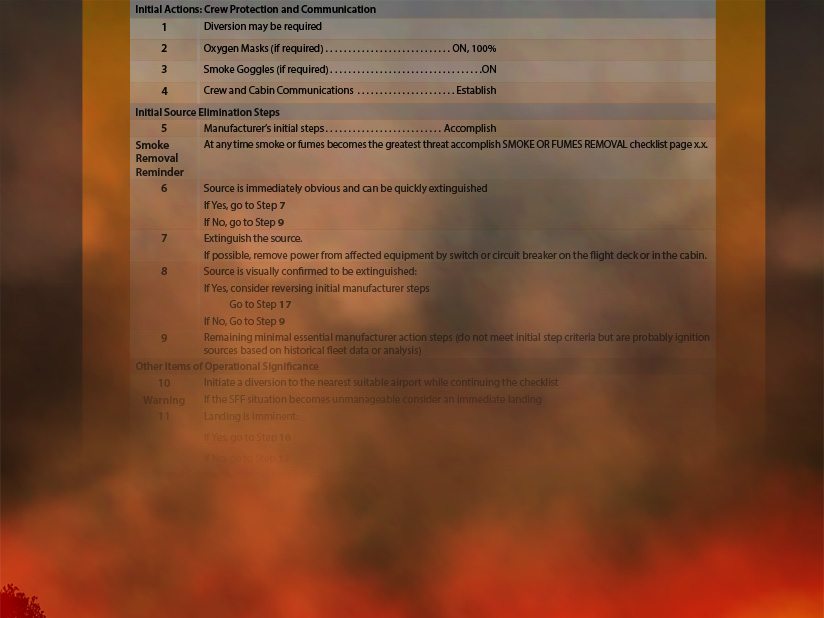
This thinking was ultimately codified in a template to guide the structure and content of checklists for these conditions.2 As can be seen in Table 1, the template differs from what had been the traditional approach for the design of these checklists in five important ways.
First, instead of separate checklists for each type of un-alerted smoke or …