

Contact: Anne Wiskerchen
Rockwell Collins
319.295.7533 office
319.651.0033 mobile
amwisker@rockwellcollins.com
Washington, D.C. and Cedar Rapids, Iowa April 26, 2010 — According to a study conducted by the Flight Safety Foundation, head-up guidance system technology, such as Rockwell Collins HGS™ Head-up Guidance System, could have prevented or positively influenced 38 percent of all commercial aircraft accidents that occurred over the past 13 years.
“Head-up Guidance Technology – A clear path to increasing flight safety,” is an independent third party study that examines use of head-up guidance system technology in modern cockpits based on digital technology. Commissioned by Rockwell Collins, the report was derived through analysis performed by the Flight Safety Foundation on information from 983 commercial air carrier, business and corporate airline accidents during the 13-year period between 1995 and 2007.
Findings also indicated that the benefits of head-up guidance technology increased in accidents where the pilot was directly involved, such as take-off and landing and loss-of-control accidents. In take-off and landing, the likelihood of accident prevention is 69 percent when a plane is equipped with head-up guidance technology. During loss-of-control accidents, the likelihood of accident prevention is 57 percent.
“Head-up guidance systems technology is a great safety tool for the prevention of runway excursions, loss of control, and approach and landing accidents,” said Bob Vandel, foundation fellow for Flight Safety Foundation. Vandel co-authored the study with Earl Weener, Ph.D. and foundation fellow. “This technology provides extremely useful data to the flight deck crew which allows them to be the pilot they always thought they were.”
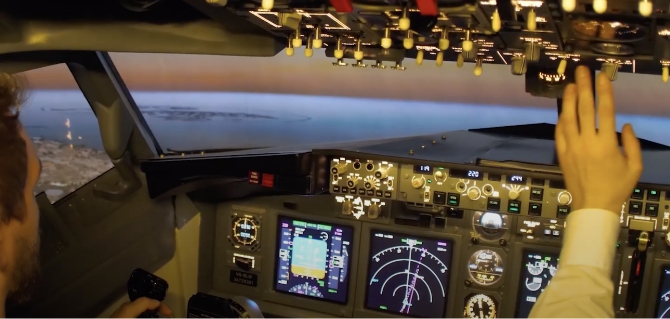
Rockwell Collins HGS displays critical flight information in the pilot’s forward field-of-view, eliminating the need for the pilot to repeatedly transition between the head-down instruments and the forward view through the windshield. As a result, pilots can keep their attention focused on the outside world, enhancing overall situational awareness and safety.
The study found that the most important information on the HGS display was consistently the flight path and speed error information, which provides the pilot with the instantaneous energy state of the aircraft and allows the pilot to see where the aircraft will be while maintaining an ‘eyes out’ view.
“This report underscores the importance of head-up guidance technology on board modern aircraft,” said David Austin, senior director, HGS at Rockwell Collins. “Our customers have always recognized the situational awareness benefits of HGS technology. However, this study goes further to underscore the critical safety value of HGS technology and the benefits of keeping the pilot in the loop even while aircraft become more automated.”
A complete copy of the report can be downloaded here.
The original Flight Safety Foundation report, “Head-up Guidance Technology – A Powerful Tool for Accident Prevention,” was published in 1990. Rockwell Collins requested the Flight Safety Foundation update this study to reflect new glass cockpit technology most aircraft fly with in today’s modern airspace.
Research Methodology
A database was developed for this updated head-up guidance technology report using the Airclaims Ltd. World Aircraft Accident Summary (WAAS) database, the Flight Safety Foundation Approach and Landing Accident database and the Flight Safety Foundation Runway Excursion database. The report focused on multi-engine turbojet and turboprop airplanes with maximum take-off gross weight of 12,500 pounds or greater, which generally represents modern glass cockpit aircraft.
The study assumed an operational head-up guidance system at the pilot flying station and a properly trained crew. Seventeen distinct safety properties of the head-up guidance technology were defined. Each of the head-up guidance technology safety properties was assessed for each accident to determine the likelihood that the respective head-up guidance technology safety property would have or likely would have prevented the accident. This was accomplished using a subjective evaluation on the part of a highly skilled safety professional. A separate audit was conducted by another safety professional to confirm the analysis standards, and to audit every 10th aircraft accident in the database to assess evaluation consistency.
About Flight Safety Foundation
Flight Safety Foundation is an independent, non-profit, international organization engaged in research, auditing, education, advocacy and publishing to improve aviation safety. The foundation’s mission is to pursue the continuous improvement of global aviation safety and the prevention of accidents. To find out more, please visit www.flightsafetstg.wpenginepowered.com
About Rockwell Collins
Rockwell Collins (NYSE: COL) is a pioneer in the development and deployment of innovative communication and aviation electronic solutions for both commercial and government applications. Our expertise in flight deck avionics, cabin electronics, mission communications, information management, and simulation and training is delivered by nearly 20,000 employees, and a global service and support network that crosses 27 countries. To find out more, please visit www.rockwellcollins.com.
Contact: Emily McGee, Director of Communications, 1-703-739-6700, ext. 126; mcgee@webdeva.flightsafety.org

