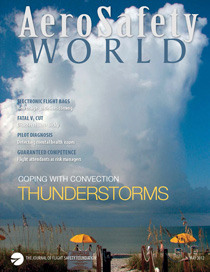
AeroSafety World May 2012 68 pages.
Severe turbulence above the ground and wind shear near the surface. Cloud tops higher than commercial aircraft can fly. Air rising and sinking at speeds that can exceed 100 mph (161 kph). All those are potential features of convection — in common language, thunderstorms.
In the May AeroSafety World cover story, atmospheric scientist Edward Brotak explains how convection works and, critically for aviation, how it can be forecast. Also in the new issue: a simulated engine failure during a check ride in an Embraer EMB-120ER that ended in a loss of control; pilot depression; lessons apparently not learned from accidents; plus other significant feature stories and regular departments. [Download PDF 8.8M]
…